The Data Protection Bill: It’s not what you think it is!

canstockphoto16666262

Yesterday the DCMS published the long awaited Data Protection Bill 2017. Accompanying the 203 pages of the Bill there are 112 pages of explanatory notes, a 4-page factsheet and a 5-page impact assessment. With detailed cross referencing to the provisions of the General Data Protection Regulation (GDPR), this Bill is a gift to purveyors of highlighters and sticky notes!

The Bill has many aims (see below). It does not though, contrary to popular belief, incorporate the GDPR into UK law. GDPR is a Regulation and so directly applicable when it comes into force on 25th May 2018. It does not need to be “signed into British law” whilst we remain members of the EU. Post Brexit the GDPR will still be the law because of the provisions of the European Union (Withdrawal) Bill (previously the Great Repeal Bill.) Paragraph 6 of the explanatory notes confirms this:

“While the UK remains a member of the EU, all the rights and obligations of EU membership remain in force. When the UK leaves the EU, the GDPR will be incorporated into the UK’s domestic law under the European Union (Withdrawal) Bill, currently before Parliament.”

So why do we need a Data Protection Bill? Section 1 explains:

To fill in some of the gaps in GDPR – what are known as “derogations”; where Members states are allowed to make their own rules. The Bill mirrors the Government’s Statement of Intent which was published a few weeks ago. Amongst many other things, we are now clearer on the minimum age at which a child can consent to certain types of data processing, the definition of a public authority/public body, new offences, rules on automated decision making and exemptions (including for research and freedom of expression in the media.)

To make provision for a broadly equivalent regime to certain types of processing to which the GDPR does not apply (see Article 2(2)) including the processing of unstructured, manual data held by an FOI public authority.

To implement Directive (EU) 2016/680 (the Law Enforcement Directive) on the protection of natural persons with regard to the processing of personal data by competent authorities for the purposes of the prevention, investigation, detection or prosecution of criminal offences or the execution of criminal penalties, and on the free movement of such data. Unlike the GDPR, the Law Enforcement Directive is not directly applicable EU law; accordingly Part 3 of the Bill, amongst other things, transposes the provisions of the Directive into UK law.

To make provision for the processing of personal data by the Intelligence Services

To make provisions about the role of the Information Commissioner

To make provisions for the enforcement of data protection legislation

The second reading of the Bill will be on 10th October. Its passage through Parliament can be tracked here.

Want to know more? Attend our Data Protection Bill workshop.

Let Act Now help with your GDPR preparations. Our full day workshops and GDPR Practitioner Certificate courses are filling up fast.

We also offer a GDPR health check service.

GDPR and the Data Protection Bill: Myths and Misunderstandings

Man Reading Book and Sitting on Bookshelf in Library

On Monday, the Government published a Statement of Intent about the forthcoming Data Protection Bill. The idea behind the Bill is to fill in some of the gaps in the General Data Protection Regulation (GDPR), which will come into force on 25th May 2018. The full text of the Bill is likely to be published in September.

The Bill follows a consultation exercise run by the DCMS earlier this year calling for views on implementation of the “derogations” under GDPR. These are areas where EU member states are left to produce their own laws to fit their circumstances while keeping within the GDPR framework. Notable derogations, amongst others, include the minimum age at which a child can consent to data processing, when data about criminal convictions and offences can be processed and exemptions (including for freedom of expression in the media.)

That’s the real background to Monday’s statement. But this did not stop the media from peddling myths and misunderstandings. Upon reading the headlines, a layman or woman would get the impression that:

The Bill gives people new rights (No it does not, the GDPR does.)

The Bill is designed to sign European privacy rules into British law

(GDPR is a Regulation and so directly applicable. It does not need to be “signed into British law” whilst we remain members of the EU. Post Brexit it will still be applicable because of the provisions of the Great Repeal Bill (More here.))

The BBC even reported that “the new law was drafted by Digital Minister, Matt Hancock.” Yesterday the story was changed to state that it was “drafted under Digital Minister, Matt Hancock.” (I have asked them about this.)

Then again the media is not entirely at fault. The Government’s statement is drafted (or spun) in such a way as to give the impression that GDPR is all their idea rather than the EU’s. Mr. Hancock, in his foreword, even suggests that the Bill is part of the Government’s grand Brexit plan (if there is a plan!):

“Bringing EU law into our domestic law will ensure that we help to prepare the UK for the future after we have left the EU.”

All this myth peddling has led to some official myth bashing too. (See the ICO’s latest blog post.)

So what have we actually learnt about the Government’s GDPR intentions? Much of the statement explains the provisions of the GDPR or states the obvious. For example that the Data Protection Act 1998 (DPA) will be repealed. As if there was any choice!

The DCMS has today published (HT Bainsey1969 and the Open Rights Group) a list of derogation in the Bill and there proposed stance (Read here). The following stand out:

  • Children and Consent – The UK will legislate to allow a child aged 13 years or older to consent to their personal data being processed (rather than 16 which is GDPR’s default position).
  • Exemptions – The GDPR allows the UK to introduce exemptions from the transparency obligations and individuals’ rights. The Government will make the same exemptions available under GDPR as currently under the Data Protection Act (see S.29-35 and schedule 7 of the DPA).
  • New Offences – The Bill will create a number of new criminal offences:

Intentionally or recklessly re-identifying individuals from anonymised or pseudonymised data, and knowingly handling or processing such data

Altering records with intent to prevent disclosure following a Subject Access Request (just like under S.77 of FOI)

Retaining data against the wishes of the Data Controller, even where the data was originally obtained lawfully (this would constitute a widening of the current offences provided for in s. 55 DPA)

  • Journalism – There will be a journalistic exemption in GDPR similar to S.32 of the DPA (balancing data protection rights with journalistic freedoms). The Information Commissioner’s Office (ICO) will have wider powers to take enforcement action in media cases.
  • Automated Decisions – There will be an exemption from the general rules in GDPR about automated decision making and profiling where such processing is in the legitimate interests of the Data Controller.
  • Research – There will be exemptions to the general rules in GDPR about Data Subjects’ rights. Research organisations and archiving services will not have to respond to subject access requests when this would seriously impair or prevent them from fulfilling their purposes. Research organisations will not have to comply with Data Subjects’ rights to rectify, restrict further processing and, object to processing where this would seriously impede their ability to complete their work, and providing that appropriate organisational safeguards are in place to keep the data secure.

Data Controllers should not wait for the Data Protection Bill to be published before starting their GDPR preparations. There is so much to do now:

  1. Raise awareness about GDPR at all levels. (Check out our full day workshop and our GDPR poster).
  2. Consider whether you need a Data Protection Officer and if so who is going to do the job.
  3. Review compliance with the existing law as well as the six new DP Principles.
  4. Review how you address records management and information risk in your organisation.
  5. Revise your privacy polices in the light of the GDPR’s more prescriptive transparency requirements.
  6. Review your information security polices and procedures in the light of the GDPR’s more stringent security obligations particularly breach notification.
  7. Write polices and procedures to deal with new and revised Data Subject rights including Data Portability and Subject Access.
  8. Consider when you will need to do a Data Protection Impact Assessment

STOP PRESS – the Bill has now been published.  Attend our Data Protection Bill workshop.

Let Act Now help with your GDPR preparations. Our full day workshops and GDPR Practitioner Certificate (GDPR.Cert) courses are filling up fast. We also offer a GDPR health check service.

Data Protection Impact Assessments under GDPR

CJgbrkzUwAAJSZA

The General Data Protection Regulation (GDPR) will come into force in about 10 months. There is plenty to learn and do before then including:

  1. Raising awareness about GDPR at all levels
  2. Reviewing how you address records management and information risk in your organisation.
  3. Reviewing compliance with the existing law as well as the six new DP Principles.
  4. Revising privacy polices in the light of the GDPR’s more prescriptive transparency requirements.
  5. Reviewing information security polices and procedures in the light of the GDPR’s more stringent security obligations particularly breach notification.
  6. Writing polices and procedures to deal with new and revised Data Subject rights such as Data Portability and Subject Access.
  7. Considering whether you need a Data Protection Officer and if so who is going to do the job.
    As well as:
  8. Considering when you will need to do a Data Protection Impact Assessment (DPIA).

Article 35 of GDPR introduces this concept. DPIAs (also known as Privacy Impact Assessments) are a tool which can help Data Controllers identify the most effective way to comply with their GDPR obligations and reduce the risks of harm to individuals through the misuse of their personal information. A well-managed DPIA will allow Data Controllers to identify and fix problems at an early stage, reducing the associated costs and damage to reputation, which might otherwise occur.

DPIAs are important tools for accountability, as they help Data Controllers not only to comply with requirements of the GDPR, but also to demonstrate that appropriate measures have been taken to ensure compliance (see Article 24)4.)

When is a DPIA needed?

Carrying out a DPIA is not mandatory for every processing operation. A DPIA is only required when the processing is “likely to result in a high risk to the rights and freedoms of natural persons” (Article 35(1)).

Such processing, according to Article 35(3)), includes (but is not limited to):

  • systematic and extensive processing activities, including profiling and where decisions that have legal effects – or similarly significant effects – on individuals.
  • large scale processing of special categories of data or personal data relating to criminal convictions or offences.
  • large scale, systematic monitoring of public areas (CCTV).

So what other cases will involve “high risk” processing that may require a DPIA? In May, the Article 29 Working Party published its data protection impact assessment guidelines for comments. We are still waiting for the final version but I don’t think its is going to change much. It sets out the criteria for assessing whether processing is high risk. This includes processing involving:

  1. Evaluation or scoring, including profiling and predicting especially from aspects concerning the Data Subject’s performance at work, economic situation, health, personal preferences or interests, reliability or behaviour, location or movements
  2. Automated decision-making with legal or similar significant effects
  3. Systematic monitoring of individuals
  4. Sensitive data
  5. Personal Data on a large scale
  6. Datasets that have been matched or combined
  7. Data concerning vulnerable Data Subjects
  8. Innovative use or application of technological or organisational solutions
  9. Data transfers across borders outside the European Union
  10. Data that Prevents Data Subjects from exercising a right or using a service or a contract

What information should the DPIA contain?

The GDPR sets out the minimum features of a DPIA (Article 35(7), and Recitals 84 and 90):

  • A description of the processing operations and the purposes, including, where applicable, the legitimate interests pursued by the Data Controller.
  • An assessment of the necessity and proportionality of the processing in relation to the purpose.
  • An assessment of the risks to individuals.
  • The measures in place to address risk, including security, and to demonstrate that the Data Controller is complying with GDPR.

A DPIA can address more than one project.

The ICO’s Code of Practice on Privacy Impact Assessments will assist as well as the Irish Data Protection Commissioner’s Guidance.

When should a DPIA be conducted?

DPIA’s should be conducted prior to the processing operation commencing. DPIAs are an integral part of taking a Privacy by Design approach which is emphasised in Article 25. The DPIA should be treated as a continual process, not a one-time exercise. Data Controllers should start it early and update it throughout the lifecycle of the project.

The GDPR comes into force on 25th May 2018, and DPIAs are legally mandatory only for processing operations that are initiated after this date. Nevertheless, the Article 29 Working Party strongly recommends carrying out DPIAs for all high-risk operations prior to this date.

Who should conduct the DPIA?

A DPIA may be conducted by the Data Controller’s own staff or an external consultant. Of course the Data Controller remains liable for ensuring it is done correctly. The Data Protection Officer’s advice, if one has been designated, must also be sought as well as the views (if appropriate) of Data Subjects or their representatives.

If the DPIA suggests that any identified risks cannot be managed and the residual risk remains high, the Data Controller must consult with the Information Commissioner before moving forward with the project. Regardless of whether or not consultation with the ICO is required, the Data Controller’s obligations of retaining a record of the DPIA and updating the DPIA in due course remain.

Even if ICO consultation is not required, the DPIA may be reviewed by the ICO at a later date in the event of an audit or investigation arising from the Data Controller’s use of personal data.

What are the risks of non-compliance?

Failure to carry out a DPIA when the processing is subject to a DPIA (Article 35(1) and (3)), carrying out a DPIA in an incorrect way (Article 35(2) and (7) to (9)), or failing to consult the ICO where required (Article 36(3)(e)), can each result in an administrative fine of up to 10 million Euros, or in the case of an undertaking, up to 2% of the total worldwide annual turnover of the preceding financial year, whichever is higher.

More about Data Protection Impact Assesments in our forthcoming webinar.

Let Act Now help with your GDPR preparations. Our full day workshops and GDPR Practitioner Certificate (GDPR.Cert) courses are filling up fast. We also offer a GDPR health check service in which we can come carry out an audit and help you prepare and fill any weaknesses.


Image credits: https://privacy.org.nz/blog/toolkit-helps-assess-your-privacy-impact/


GDPR is here to stay but what happens next?

It’s official. The General Data Protection Regulation (GDPR) is here to stay; well beyond April 2019 when the UK is likely to finally leave the European Union.

On 24th October 2016, the Secretary of State Karen Bradley MP used her appearance before the Culture, Media and Sports Select Committee to say:

“We will be members of the EU in 2018 and therefore it would be expected and quite normal for us to opt into the GDPR and then look later at how best we might be able to help British business with data protection while maintaining high levels of protection for members of the public.”

Writing on her blog the Information Commissioner (Elizabeth Denham) welcomed this announcement. However it is technically incorrect for her to say:

“The government has now confirmed that the UK will be implementing the General Data Protection Regulation (GDPR).”keep-calm-and-prepare-for-the-gdpr

As I have explained in a previous blog post, the Government has no choice but to implement GDPR as the UK will still be a member of the EU on 25th May 2018 when it comes into force.

This announcement does though put an end to months of uncertainty as Data Controllers waited to see what the Government would do after the UK leaves the EU. Although last month’s announcement of the Great Repeal Bill meant that yesterday’s announcement was not a big surprise.

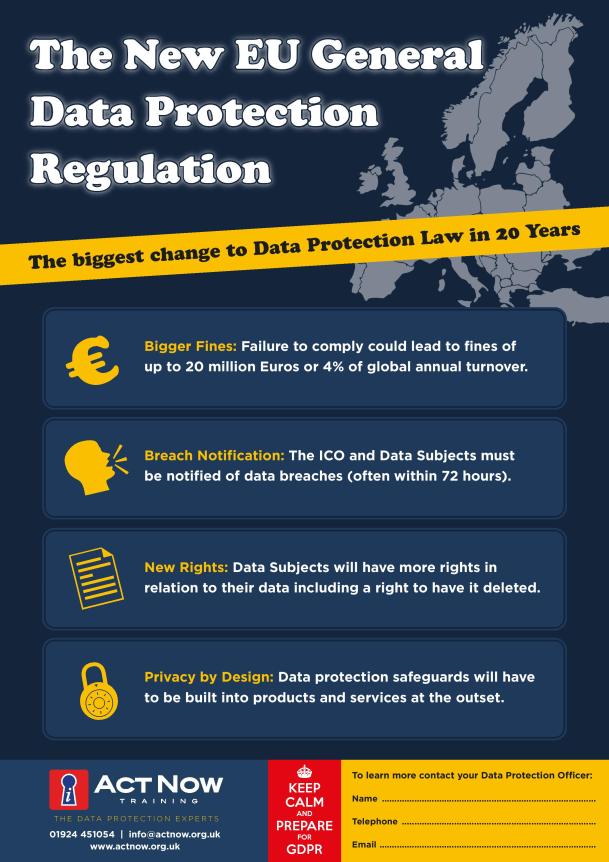
GDPR will replace the Data Protection Act 1998 (DPA) and represents the biggest change to data protection law for 20 years. With some GDPR breaches carrying fines of up to 4% of global annual turnover or 20 million Euros, now is the time to start planning (if you have not already started!).

The ICO’s overview of GDPR is a good place to start. It has also published 12 steps to take towards compliance. We would emphasise:

  1. Raising awareness of GDPR at all levels within the organisation (See our GDPR poster).
  2. Reviewing compliance with the existing law as well as the six new DP Principles.
  3. Revising privacy polices in the light of the GDPR’s more prescriptive transparency requirements. The ICO’s new privacy notices code is a very useful document for this.
  4. Considering who is going to fulfill the mandatory role of Data Protection Officer. What skills do they have and what training will they need? Our Data Protection Practitioner Certificate, with an emphasis on the practical skills requited to implement GDPR, is an ideal qualification for those aspiring for such positions.
  5. Reviewing information security polices and procedures in the light of the GDPR’s security obligations particularly breach notification.

Look out also for amendments to Section 40 of the Freedom of Information Act 2000, Section 38 of the Freedom of Information (Scotland) Act 2002, Regulation 13 of the Environmental Information Regulations 2004 and Regulation 11 of the Environmental Information (Scotland) Regulations 2004. All contain exemptions from disclosure of personal data by reference to the DPA.

The ICO will be publishing a revised timeline setting out what areas of guidance it will be prioritising over the next six months. Elisabeth Denham ends her blog with these wise words:

“I acknowledge that there may still be questions about how the GDPR would work on the UK leaving the EU but this should not distract from the important task of compliance with GDPR by 2018.”

Act Now has a series of blog posts as well as a dedicated GDPR section on its website with detailed guidance on different aspects of the Regulation.

We are running a series of GDPR webinars and workshops and our team of experts is available to come to your organisation to deliver customised workshops as well as to carry out GDPR health checks and audits. 

GDPR Practitioner Certificate (GDPR.Cert) – A 4 day certificated course aimed at those undertaking the role of Data Protection Officer under GDPR whether in the public or the private sector.

Data Protection Reform after Brexit. Does GDPR still matter?

gdprAccording to the new Prime Minister “Brexit means Brexit.” But what does Brexit mean for UK Data Controllers who are planning for implementation of the new General Data Protection Regulation (GDPR)? The short answer is keep calm and carry on.

GDPR received formal adoption by the European Parliament in April 2016 and was published on 4th May in the Official Journal. This means that it will be directly applicable throughout EU member states (without the need for implementing legislation) from 25th May 2018. Following the referendum result, you might be forgiven for thinking that you can shred your copy of the Regulation or indeed cancel your place on our very popular GDPR workshop.

The UK may have voted to leave the EU but formal divorce proceedings cannot begin until it notifies the EU of its intention to invoke Article 50 of the Lisbon Treaty. This gives negotiators two years from the date of notification to conclude new arrangements. The newly appointed Secretary of State for Exiting the European Union, David Davis, has said Article 50 should be “triggered before or by the beginning of next year.” Therefore the UK could leave the EU by December 2018 at the earliest. Consequently there would be at least six months where UK Data Controllers would have to abide by all the provisions of GDPR. In reality exiting the EU could take much longer than two years and so we could be stuck with GDPR for much longer.

In the unlikely event that Brexit negotiations are concluded before May 2018, the DPA is still living on borrowed time. Immediately after the Brexit vote the Information Commissioner’s Office (ICO), released a statement saying:

“If the UK wants to trade with the Single Market on equal terms we would have to prove ‘adequacy’—in other words UK data protection standards would have to be equivalent to the EU’s General Data Protection Regulation framework starting in 2018.”

In a speech on 4th July 2016 the then Minister for Data Protection, Baroness Neville-Rolfe, touched on the future of data protection: (HT Panopticon Blog)

One thing we can say with reasonable confidence is that if any country wishes to share data with EU Member States, or for it to handle EU citizens’ data, they will need to be assessed as providing an adequate level of data protection. This will be a major consideration in the UK’s negotiations going forward….”

The law firm, Bird and Bird, have set out the options available to the UK in terms of exiting the EU and its implications for data protection. Each of these options makes it likely that either the GDPR or a very close cousin will be required in the UK after Brexit takes effect.

Regardless of what data protection path the UK chooses, UK companies with European customers and operations have to continue with preparations. This is because GDPR will apply to any entity offering goods or services (regardless of payment being taken) and any entity monitoring the behaviours of citizens residing within the EU. Companies will be directly responsible for GDPR compliance wherever they are based (and not just their EU based offices) as long as they are processing EU citizens’ personal data.

Recently on the ICO’s Blog,  the message was reiterated that GDPR is still relevant and preparation must continue:

“We’ve been working hard on producing a set of guidance on GDPR, with an overview of the law being the first substantive part of that. We still think it will be useful to publish this overview. This is because once implemented in the EU, the GDPR will be relevant for many organisations in the UK – most obviously those operating internationally. The other main reason is that the GDPR has several new features – for example breach notification and data portability. Therefore, we thought it would still be useful to familiarise information rights professionals with the GDPR’s main principles and concepts.”

 Data Controllers have two years to prepare for the biggest change to the EU data protection regime in 20 years.  Many provisions such as breach notification and the new DP Principles will require careful planning. With some GDPR breaches carrying fines of up to 4% of global annual turnover or 20 million Euros, a “wait and see” approach would be very risky.

How Act Now can help

The next two years need to be spent wisely. Training and awareness (see our poster) at all levels needs to start now. We are running a series of GDPR webinars and workshops and our team of experts is available to come to your organisation to deliver customised data protection/GDPR workshops as well as to carry out health checks and audits. GDPR requires many Data Controllers to appoint a dedicated Data Protection Officer. Our GDPR Practitioner Certificate, with an emphasis on the practical skills requited to implement GDPR, is an ideal qualification for those aspiring for such positions.

And if you like our image, it, as well as some others are available as A3 Posters for the office for only £5 for three!  Take a look at the link below.

http://www.actnow.org.uk/posters

The GDPR Practitioner Certificate (GDPR.Cert) is aimed at those undertaking the role of Data Protection Officer under GDPR whether in the public or the private sector.

To Brexit or not to Brexit…

canstockphoto35750834


That is the question on everyone’s lips right now. With the EU referendum looming, the next big question is, How will the GDPR affect us should we decide to leave the EU? The majority opinion is that we will be definitely affected in some way or other by the regulation and most likely will have to adopt all of it, maybe in a slower timeframe… But there’s no escaping it!

There’s three likely outcomes should we leave the EU…

  1. We remain in the European free trade association or Economic area (EEA) of the EU similar to Norway in which case we would then be subjected to GDPR, in order to trade with the EU
  1. We leave all trade agreements and become similar to the USA – a ‘safe third country’, in which case we would have to have a suitable level of DP Regulation which for all intents and purposes will be the GDPR
  1. We completely go solo like Geri Halliwell, Robbie Williams, Zayn Malik…okay i’ll stop. Even in this scenario, we would have to make our own singles, do our own world tours… sorry, i mean have our own equivalent GDPR, or update our existing one and where better to find one? (I can sense a Blue Peter moment coming on…)

So in short… and forgive me for my Hunger Games level of enthusiasm of being selected in the games, but GDPR is coming one way or the another…The Real Question is… Are You Ready?

Let the Games Begin!


Act Now can Help you prepare for the regulation. We have full day courses on the regulation as well as courses available online. Please visit our website here to find out more.