Another Conservative Party GDPR Breach 

Yesterday, Rachel Cunliffe, Associate Political Editor of the New Statesman, reported that she had received an email from the Conservative Campaign Headquarters (CCHQ) about their forthcoming conference. However she could also see the other 344 recipients as they were all listed in the “To” box, along with their email addresses. CCHQ had made the classic mistake of failing to use blind carbon copy (BCC) and thus, by exposing the personal data of recipients, breached the UK GDPR. 

Failure to use BCC correctly in emails is one of the top data breaches reported to the ICO every year. But this incident is not just about exposing some email addresses. Recipients of the CCHQ email will be able to make assumptions about the political affiliations of their fellow recipients. Even if these assumptions are wrong, the emails can be classed as Special Category Data under the UK GDPR and thus more sensitive than other personal data. 

So can the CCHQ expect a knock on the door from the ICO? Will they be fined? Whatever your political persuasion, you may think this error from those who run the Government, deserves the strongest sanction. As Cunliffe writes: 

“If you can’t trust the Conservatives with your email address, why should you trust them with anything else.”  

Inadvertent disclosure of personal data email, by failing to use BCC, has been the subject of a number of GDPR enforcement actions by the ICO in the past few years. Just last December, the Ministry of Defence (MoD) was fined £350,000 for disclosing personal information of people seeking relocation to the UK shortly after the Taliban took control of Afghanistan in 2021.  In October 2021, HIV Scotland was issued with a £10,000 fine when it sent an email to 105 people which included patient advocates representing people living with HIV. From the personal data disclosed, an assumption could be made about individuals’ HIV status or risk; also Special Category Data.  

The ICO could follow the above examples and issue a fine; although in two recent cases it has gone for a softer option. Last year the Patient and Client Council (PCC) and the Executive Office were the subject of ICO reprimands for disclosing personal data in the same way.   

In statement issued on X, the ICO said: 

“The Conservative Party has made us aware of this incident and we are assessing the information provided.” 

The Conservative Party has form when it comes to GDPR non-compliance. 
Recently we wrote about The Good Law Project’s challenge to the Tory’s “data harvesting” from users of its online tax calculator. But this latest data breach is about more than GDPR compliance. To quote Rachel Cunliffe again: 

“This is such a basic error, so easily avoided, it inevitably sets alarm bells ringing. If CCHQ doesn’t have the staff and training procedures to prevent a classic email-sharing error, what does that say about their resilience as a whole? How are their cybersecurity defences? What else is getting missed?” 

The breach came on the day Rishi Sunakgave a speech to the Policy Exchange about the power of technology and how he, rather than Keir Starmer, could keep us safe.  You can watch Sunak’s speech here although we prefer comedian Matt Green’s brilliant satirical take on it here.

We have two workshops coming up (How to Increase Cyber Security and Cyber Security for DPOs) which are ideal for organisations who wish to upskill their employees about data security.

Navigating Turbulence: Qantas App Privacy Breach Sparks Concerns 

Today a number of news outlets are reporting that Australian airline Qantas is investigating a privacy breach on its app. Customers discovered that they had access to the personal details of other travellers, including boarding passes and frequent flyer information. This discovery has raised significant concerns about data security and privacy among Qantas app users. 

Qantas responded to the situation, acknowledging the issue and assuring customers that it was under investigation. Within three hours of the breach being detected, the airline claimed to have resolved the problem and issued a public apology for any inconvenience caused. 

Despite initial fears of a cyberattack, Qantas stated that the breach was likely due to a technology glitch, possibly linked to recent system updates. However, the extent of the breach was troubling, with some users reporting the ability to view multiple passengers’ details with just a few clicks. 

Customers shared their experiences on social media platforms, recounting instances where they were confronted with strangers’ personal information upon opening the app. Concerns were further amplified when reports emerged of individuals being able to manipulate flight bookings, raising questions about the app’s security measures. 

In response to the breach, Qantas advised affected users to log out and log back into the app to mitigate the issue. The airline reassured customers that there were no indications of travellers using incorrect boarding passes as a result of the breach. 

Social media channels buzzed with criticism of Qantas, with users sharing screenshots of the glitch and raising awareness of potential phishing attempts. Allegations surfaced of fake Qantas customer care accounts soliciting personal information from users under the guise of assistance. 

Does the UK GDPR apply here? 

In October 2020, the UK Information Commissioner’s Office fined British Airways £20million, under the GDPR, for a cyber security breach which saw the personal and financial details of more than 400,000 customers being accessed by attackers.   

Whilst Qantas has said that this incident was not due to a cyber-attack, it will certainly face questions about its handling of customer data under Australian data protection laws. It is also possible that Qantas, an Australian company,  is the subject of a probe by the UK Information Commissioner’s Office under the UK GDPR if, as is likely, UK data subjects are affected by the incident.  

Article 3(2) of the UK GDPR gives it an extra territorial effect. It states:  

“This Regulation applies to the relevant processing of personal data of data subjects who are in the United Kingdom by a controller or processor not established in the United Kingdom where the processing activities are related to: 

(a) the offering of goods or services, irrespective of whether a payment of the data subject is required, to such data subjects in the United Kingdom; or 

(b) the monitoring of their behaviour as far as their behaviour takes place within the United Kingdom.” 

Applying this principle, On 4th April 2023, the ICO issued a £12.7 million fine to TikTok, a US company owned whose parent company is owned by Beijing based ByteDance, for a number of breaches of the UK GDPR, including failing to use children’s personal data lawfully.   

As Qantas works to address the fallout from this breach and restore trust among its customer base, the incident serves as a stark reminder of the importance of robust data security measures in the digital age. It highlights the vulnerability of personal data in online platforms and underscores the need for companies to prioritise the protection of customer data. 

We have two workshops coming up (How to Increase Cyber Security and Cyber Security for DPOs) which are ideal for organisations who wish to upskill their employees about data security. We have also just launched our new workshop, Understanding GDPR Accountability and Conducting Data Protection Audits.  

YMCA Fined for HIV Email Data Breach 

Another day and another ICO fine for a data breach involving email! The Central Young Men’s Christian Association (the Central YMCA) of London has been issued with a Monetary Penalty Notice of £7,500 for a data breach when emails intended for those on a HIV support programme were sent to 264 email addresses using CC instead of BCC, revealing the email addresses to all recipients. This resulted in 166 people being identifiable or potentially identifiable. A formal reprimand has also been issued

Failure to use blind carbon copy (BCC) correctly in emails is one of the top data breaches reported to the ICO every year. In December 2023, the ICO fined the Ministry of Defence (MoD) £350,000 for disclosing personal information of people seeking relocation to the UK shortly after the Taliban took control of Afghanistan in 2021. Again the failure to use blind copy when using e mail was a central cause of the data breach. 

Last year the Patient and Client Council (PCC) and the Executive Office were the subject of ICO reprimands for disclosing personal data in this way. In October 2021, HIV Scotland was issued with a £10,000 GDPR fine when it sent an email to 105 people which included patient advocates representing people living with HIV. All the email addresses were visible to all recipients, and 65 of the addresses identified people by name. From the personal data disclosed, an assumption could be made about individuals’ HIV status or risk.  

Organisations must have appropriate policies and training in place to minimise the risks of personal data being inappropriately disclosed via email. To avoid similar incidents, the ICO recommends that organisations should: 

  1. Consider using other secure means to send communications that involve large amounts of data or sensitive information. This could include using bulk email services, mail merge, or secure data transfer services, so information is not shared with people by mistake.  
  1. Consider having appropriate policies in place and training for staff in relation to email communications.  
  1. For non-sensitive communications, organisations that choose to use BCC should do so carefully to ensure personal email addresses are not shared inappropriately with other customers, clients, or other organisations. 

More on email best practice in the ICO’s email and security guidance

We have two workshops coming up (How to Increase Cyber Security and Cyber Security for DPOs) which are ideal for organisations who wish to upskill their employees about data security. We have also just launched our new workshop, Understanding GDPR Accountability and Conducting Data Protection Audits. 

The MoD GDPR Fine: The Dangers of Email 

Inadvertent disclosure of personal data on email systems has been the subject of a number of GDPR enforcement actions by the Information Commissioner’s Office (ICO) in the past few years. In 2021, the transgender charity Mermaids was fined £25,000 for failing to keep the personal data of its users secure. The ICO found that Mermaids failed to implement an appropriate level of security to its internal email systems, which resulted in documents or emails containing personal data being searchable and viewable online by third parties through internet search engine results. 

Failure to use blind carbon copy (BCC) correctly in emails is one of the top data breaches reported to the ICO every year. Last year the Patient and Client Council (PCC) and the Executive Office were the subject of ICO reprimands for disclosing personal data in this way. In October 2021, HIV Scotland was issued with a £10,000 GDPR fine when it sent an email to 105 people which included patient advocates representing people living with HIV. All the email addresses were visible to all recipients, and 65 of the addresses identified people by name. From the personal data disclosed, an assumption could be made about individuals’ HIV status or risk.  

The latest GDPR fine was issued in December 2023, although the Monetary Penalty Notice has only just been published on the ICO website. The ICO has fined the Ministry of Defence (MoD) £350,000 for disclosing personal information of people seeking relocation to the UK shortly after the Taliban took control of Afghanistan in 2021. 

On 20th September 2021, the MoD sent an email to a distribution list of Afghan nationals eligible for evacuation using the ‘To’ field, with personal information relating to 245 people being inadvertently disclosed. The email addresses could be seen by all recipients, with 55 people having thumbnail pictures on their email profiles.
Two people ‘replied all’ to the entire list of recipients, with one of them providing their location. 

The original email was sent by the team in charge of the UK’s Afghan Relocations and Assistance Policy (ARAP), which is responsible for assisting the relocation of Afghan citizens who worked for or with the UK Government in Afghanistan.
The data disclosed, should it have fallen into the hands of the Taliban, could have resulted in a threat to life. 

Under the UK GDPR, organisations must have appropriate technical and organisational measures in place to avoid disclosing people’s information inappropriately. ICO guidance makes it clear that organisations should use bulk email services, mail merge, or secure data transfer services when sending any sensitive personal information electronically. The ARAP team did not have such measures in place at the time of the incident and was relying on ‘blind carbon copy’ (BCC), which carries a significant risk of human error. 

The ICO, taking into consideration the representations from the MoD, reduced the fine from a starting amount of £1,000,000 to £700,000 to reflect the action the MoD took following the incidents and recognising the significant challenges the ARAP team faced. Under the ICO’s public sector approach, the fine was further reduced to £350,000.  

Organisations must have appropriate policies and training in place to minimise the risks of personal data being inappropriately disclosed via email. To avoid similar incidents, the ICO recommends that organisations should: 

  1. Consider using other secure means to send communications that involve large amounts of data or sensitive information. This could include using bulk email services, mail merge, or secure data transfer services, so information is not shared with people by mistake.  
  1. Consider having appropriate policies in place and training for staff in relation to email communications.  
  1. For non-sensitive communications, organisations that choose to use BCC should do so carefully to ensure personal email addresses are not shared inappropriately with other customers, clients, or other organisations. 

More on email best practice in the ICO’s email and security guidance

We have two workshops coming up (How to Increase Cyber Security and Cyber Security for DPOs) which are ideal for organisations who wish to upskill their employees about data security. We have also just launched our new workshop, Understanding GDPR Accountability and Conducting Data Protection Audits. 

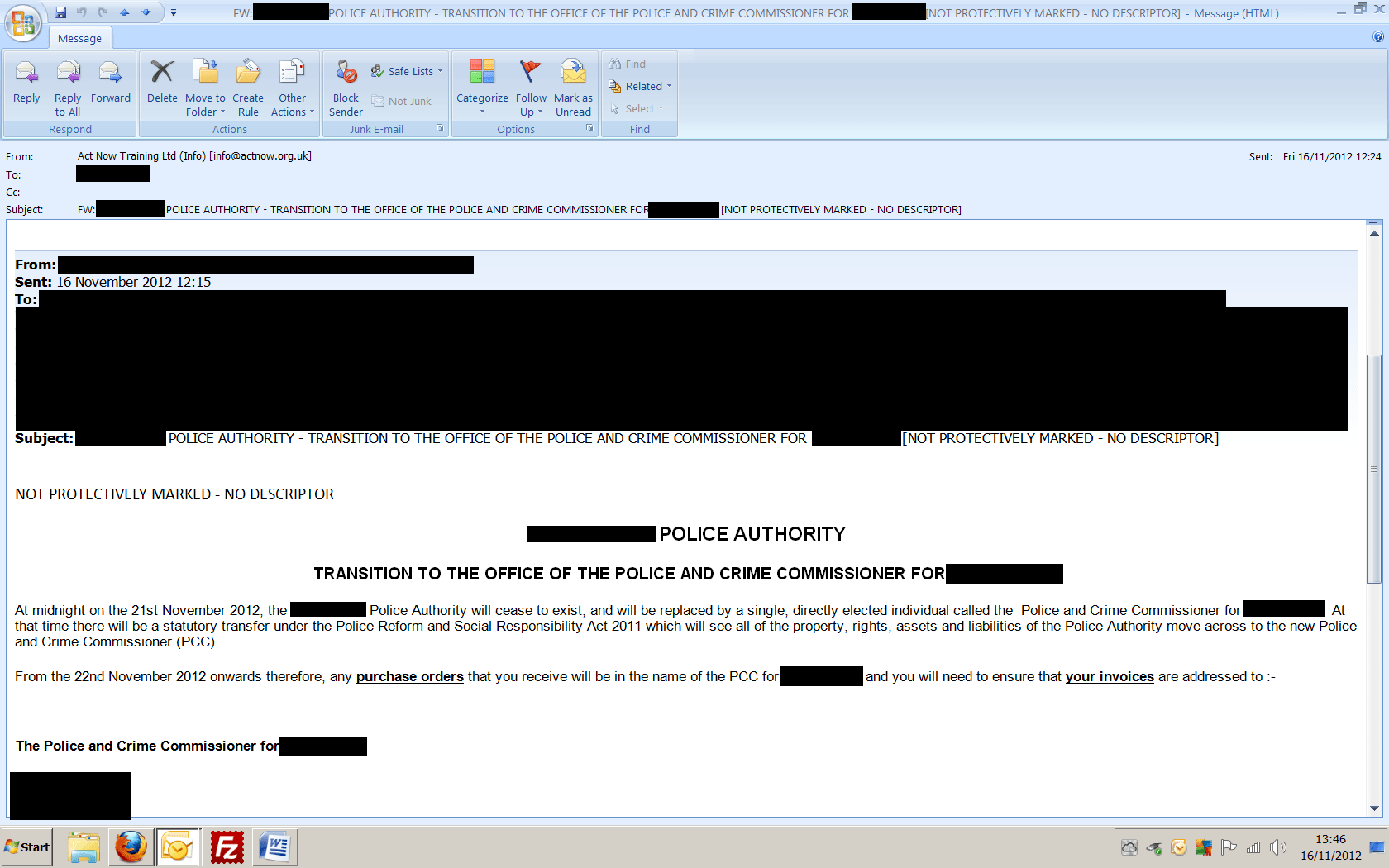
What’s the difference between PCC & BCC

The picture that said a thousand suppliers.

Fresh from being elected with less than 10% of the electorate in favour of him a recently appointed Police Commissioner writes to all the suppliers to tell them the email addresses of all their suppliers (and a few extra organisations – such as rape crisis centres, police officers, probation officers and some personal email addresses).  Still no harm done eh? No law broken, no real personal data involved. No brain cells used in the distribution of this list.

Makes me feel like Phillip Schofield. (When I say this it doesn’t mean I feel like him as in desire him – more like feel I’m in a similar predicament…)