Sort of Fair Processing Notice

Walking through Huddersfield the other day I caught this interesting example of a fair processing notice. It was a bus shelter. The actual notice was well above the normal range of vision. (Which reminds me of an old joke. What lies on its back eight feet up in the air.  Answer later.)

But how fair is this sign? Is it a fair processing notice informing data subjects that they might be being filmed? It has the magic acronym CCTV so there’s definitely a possibility that filming is taking place. But the other words seem to confuse the issue.

Anti-social behaviour is a crime. We’re not going to disagree with that are we? but it’s a statement of fact not really what’s needed on an FPN. You might as well say that Chelsea won the Champion’s League this year.

Plain Clothes Police Officers.  So how do we know they are Police Officers? Do they wear a carnation in their lapel or are they really operating covertly? This phrase means that everyone on the streets may be a police officer. Is this fair? Or if covert operations are being undertaken why do we say that plain clothes police officers are in place. Isn’t covert er… wait for it… covert? Does RIPA ring a bell?

Or CCTV in use.  Whoa let’s take a rain check.  Either it is in use or it isn’t. If it is you put up signs saying who’s doing it, why and contact details. If it’s not you don’t. Or maybe it’s secret filming. Donnnngggg. (That’s an alliteration denoting the tolling of the RIPA bell)

Finally your behaviour could be under observation. Back to the previous paragraph. Either it is or it isn’t. If it is for general crime prevention purposes then put up signs. If it’s a covert operation pre-authorise it through your SPOC and don’t bother with signs.

And to finish off 7 (count them) individual organisations contributed to this sort of fair processing notice including some very well known ones. So 7 data protection persons gave their opinion on the poster. No-one thought it was a bit naff.   Or maybe they didn’t ask the DP persons.

Take care in Huddersfield. They might be filming you (or not). Anyone at all could be a police officer. And Chelsea won the Champions League.

Ah yes the answer to the question.

What lies on its back eight feet up in the air. A dead spider.

Protection of Freedoms Act 2012

Protection of Freedoms Act 2012

 2012 CHAPTER 9

The Protection of Freedoms Act 2012 received Royal Assent on 1st May 2012. The Act contains a number of measures which, when brought into force, will have a major impact on public authorities especially councils. Amongst other things the Act:

Introduces a new code of practice for surveillance camera systems. This is in addition to the CCTV Code of Practice under the Data Protection Act 1998. There will also be a surveillance camera commissioner. Read our article on  the New CCTV Regime 

  • Extends the Freedom of Information Act by requiring datasets to be made available in a re-usable electronic format. Read our blog entry on how this can make you money. For details of an innovative use of a dataset click here
  • Provides for Magistrates’ approval of all surveillance activities by local authorities under RIPA. Read a full article on the changes.
  • Requires schools to obtain parents’ consent before processing children’s biometric information
  • Restrict the scope of the ‘vetting and barring’ scheme for protecting vulnerable groups and makes changes to the system of criminal records checks. Read our article

Ibrahim Hasan is doing a special online training session  on the new Act in June and July.

The Act will also:

  • bring in a new framework for police retention of fingerprints and DNA data
  • provide for a code of practice to cover officials’ powers of entry, with these powers being subject to review and repeal
  • outlaw wheel-clamping on private land
  • introduce a new regime for police stops and searches under the Terrorism Act 2000 and reduces the maximum pre-charge detention period under that Act from 28 to 14 days
  • enable those with convictions for consensual sexual relations between men aged 16 or over (which have since been decriminalised) to apply to have them disregarded

All our information and surveillance law courses will be updated to take account of the new Act. If you would like customised in house training on any aspects of the Act, please get in touch.

FPN & CCTV

Not sure why but when a normally rational DP officer is asked to produce a Fair Processing Notice for a CCTV camera they seem to lose track of reality and forget the basics. Name of Data Controller; purpose of processing, contact details.

Here’s a simple example.

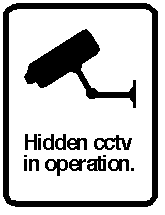
Forgot almost everything and also made the mistake of telling people that they were using hidden cameras. Hidden engages RIPA. Easy mistake to make.

Another fine example of this on the right is a well known police force.

Clearly they thought about what to put on their sign but managed to get it spectacularly wrong.

And while the Act Now staff are abroad they also keep their eyes open for interesting signs. Souriez means Smile. We’ve seen versions of this in the UK.

And a colleague sent the following to me knowing I had a library of CCTV signs collected on my travels.


How we laughed… But then we realised… what do our CCTV signs look like? Is anyone snapping ours and showing them off as not actually very good…   Send us your signs.

CCTV and the Law Workshop – Watching You Watching Them More details – http://www.actnow.org.uk/courses/714

DP & FOI. Coming to a school near you.

It may have sneaked under the radar in and around Xmas but an FOI request in Wales to schools produced some alarming stats.

There are at least 2,840 cameras in schools across Wales, one school in Cardiff has 40 cameras for around 190 pupils. Just over a third of all the schools in Wales responded to the Freedom of Information Act request asking about CCTV use on their premises. That means that two thirds don’t do CCTV or worse than that they didn‘t realise they had to reply to FOI requests.

Of the 602 that replied, 519 provided some or all of the information requested while 83 refused to answer any of the questions.

Of those surveyed, 54% admitted they had not given full information about the location of cameras and times they were filming to parents.

This is neither rocket science nor brain surgery. If you use CCTV cameras you tell people likely to be filmed that you are doing it. It’s called fair processing and is Principle 1 of the Act. The simple solution is putting up signs at every entrance to the school grounds saying that filming is taking place and why. Design them yourself if you feel like it or you can buy them cheaply from many office suppliers. What you don’t do is not tell parents & pupils that you’re filming. Failure to comply with a principle can lead to a criminal offence. Principle 1 says processing should be Fair and Lawful.

Furthermore if someone asks a question using Freedom of Information about a process (CCTV) that should be part of a fair processing notice and 83 schools refuse to answer some-one somewhere should ask to see their refusal notices (sounds like FOI request to me) as there are no real grounds for refusing as the information should already supplied to Parents & Pupils. Doesn’t the commissioner have the power to issue an enforcement notice without a complaint if he feels there is an issue that needs addressing? Is 83 schools a big issue?

See the report and the spreadsheets that support this at http://tinyurl.com/78bydsw

But before we all harrumph at the standard of compliance with Information Law in welsh schools let’s ask our local school some simple questions.

  • Can I see your Publication Scheme?
  • Please give me a copy of your Privacy policy.
  • Do you use CCTV in the school?
  • Can I see a copy of your Notification?

You should get 4 answers by return all reassuring you that your local school knows what it’s doing. One missing or a long delay and you know something just ain’t right.

If you want to be more sneaky you can see if your local school has notified their processing to the ICO by searching the register of Data Controllers. You may be surprised. At a course in the North East a few years ago we had over 30 schools in the audience. I suggested that at coffee break we could get online and check a few schools to see if they were on the ICO’s register. We tried 6 before we found one who had done it. (An offence – Section 17 followed by Section 21).

Act Now has a briefing for schools on DP & FOI. Half a day at venues throughout the UK. We also have online courses in this area. See http://www.actnow.org.uk/courses/Schools